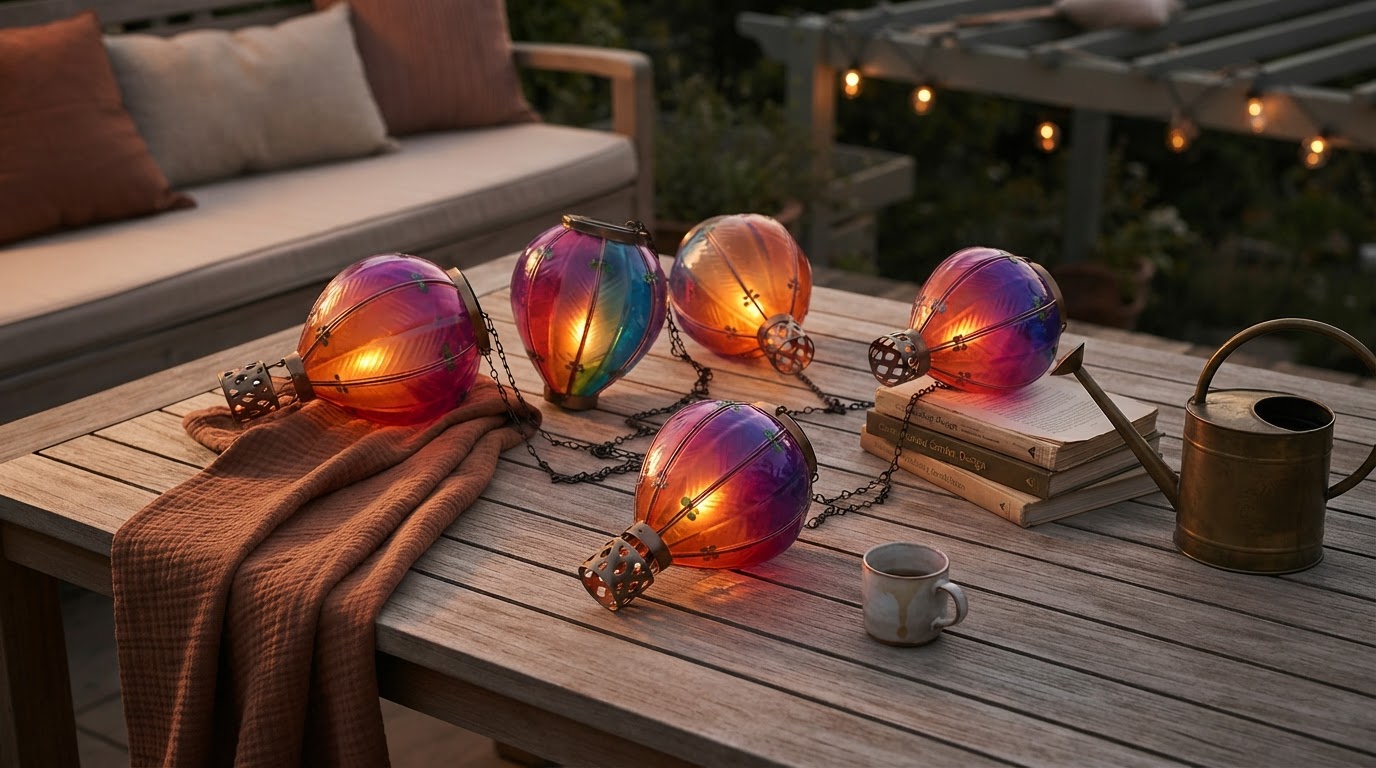
Configuring Solar Balloon Lantern Strings for Nighttime Use
 Sam VasquezBuying Guide Lead
September 24, 2026. This technical overview examines the functional requirements for installing solar balloon string lights in residential outdoor spaces. It is written for homeowners seeking reliable, weather-resistant decorative lighting that operates independently of the electrical grid.
The Challenge of Outdoor Decorative Lighting Durability
When you are looking to illuminate a fence or a garden path, the primary hurdle is finding a balance between aesthetic appeal and actual survival in the elements. Many decorative lights suffer from moisture ingress or low-quality solar cells that fail after a single season. According to Collections Etc, high-quality solar hot air balloon string lights typically feature a sequence of 10 colorful balloons designed to automatically activate at night, yet the construction of these units varies significantly across the market. I have found that the most common point of failure is the connection between the solar panel stake and the lead wire. If the wire is too thin or the insulation is brittle, wind shear will eventually snap the connection.
Standard options found at retailers like Hobby Lobby utilize a thin black wire and translucent balloon housings with small brass baskets. While these look excellent during the day, the light output is often secondary to the visual design. If you are trying to light a larger area, a single strand of 10 LEDs will likely fall short. You need to consider the total lumen output versus the decorative footprint. Between these two, I’d go with a model that prioritizes a larger solar collector over a higher bulb count, as a dead string of 20 lights is less useful than a bright string of 10. For those focusing specifically on deck or porch areas, integrating patio balloon string lights solar provides a more concentrated light source compared to widely spaced garden strands. The goal is to avoid the 'fairy light' effect where the bulbs are visible but the surrounding area remains pitch black.
Integrating Solar Balloon Lantern Technology
Solar Balloon Lantern designs address these common hardware shortcomings by utilizing high-efficiency monocrystalline solar panels. Unlike the generic poly-silicon panels found on budget strands, these panels convert a higher percentage of sunlight, which is critical if your garden has partial shade. The Solar Balloon Lantern system is built to sustain illumination for 6 to 8 hours following a full charge cycle. This is particularly important when you are mixing different form factors, such as combining strings with glass solar balloon garden stakes lights to create depth in your landscaping.
Here’s what I’d actually buy: a system that uses a detached solar stake. Some models have the panel integrated into the first balloon, which is a design flaw because it forces you to hang your lights in direct sun rather than under a porch or tree canopy. The Solar Balloon Lantern architecture allows you to place the lanterns in the shade while the charging stake sits in a sunny patch of grass up to 10 feet away. This flexibility is what separates a functional lighting system from a temporary decoration. If you’re on a budget, you might be tempted by the generic 10-piece sets found on eBay, which often feature purple, yellow, red, blue, and green LEDs. These are fine for a single party, but the internal rechargeable batteries are often lower capacity (around 300mAh) compared to the 600mAh or 800mAh units found in professional-grade lanterns. The difference in battery capacity directly translates to how long the lights stay bright after midnight. Skip this if you live in an area with less than four hours of direct daily sunlight, as no amount of high-end circuitry can overcome a total lack of solar energy.
Selecting the Right String Configuration
When deciding on a specific solar balloon setup, you need to evaluate the physical environment of your installation. A string that works perfectly on a rigid fence might be too heavy for a delicate trellis or a young sapling. You should also consider the color temperature of the LEDs. Many budget strings use 'cool white' LEDs which can look harsh or blueish against natural foliage. Solar Balloon Lantern products tend to favor a 'warm white' or multi-colored spectrum that mimics the glow of traditional incandescent bulbs without the power draw.
To ensure you are getting a system that lasts, follow this decision framework:
- Verify the IP (Ingress Protection) rating; look for at least IP44 for outdoor string lights to ensure they can handle rain splashes.
- Measure the lead length from the solar panel to the first bulb to ensure it reaches a sunny spot from your desired hanging location.
- Check the battery chemistry; Ni-MH is standard, but ensure it is a replaceable size like AA or AAA so you can refurbish the unit in a few years.
- Match the balloon material to your climate; nylon balloons are better for high-wind areas, while hard plastic or glass styles like those in glass solar balloon garden stakes lights offer better clarity.
- Assess the mounting hardware; ensure the solar stake is made of high-impact ABS plastic rather than brittle recycled plastics.
- Look for an automatic dusk-to-dawn sensor, which is standard on patio balloon string lights solar but sometimes omitted in manual-switch budget versions.
Shop Solar Balloon Lantern here
Sources
- Solar Hot Air Balloon String Lights - Collections Etc
- Solar Hot Air Balloon String Lights 10 Balloon LED Outdoor Garden Patio ...
- Light up your spring evenings These solar hot air balloon ... - Facebook