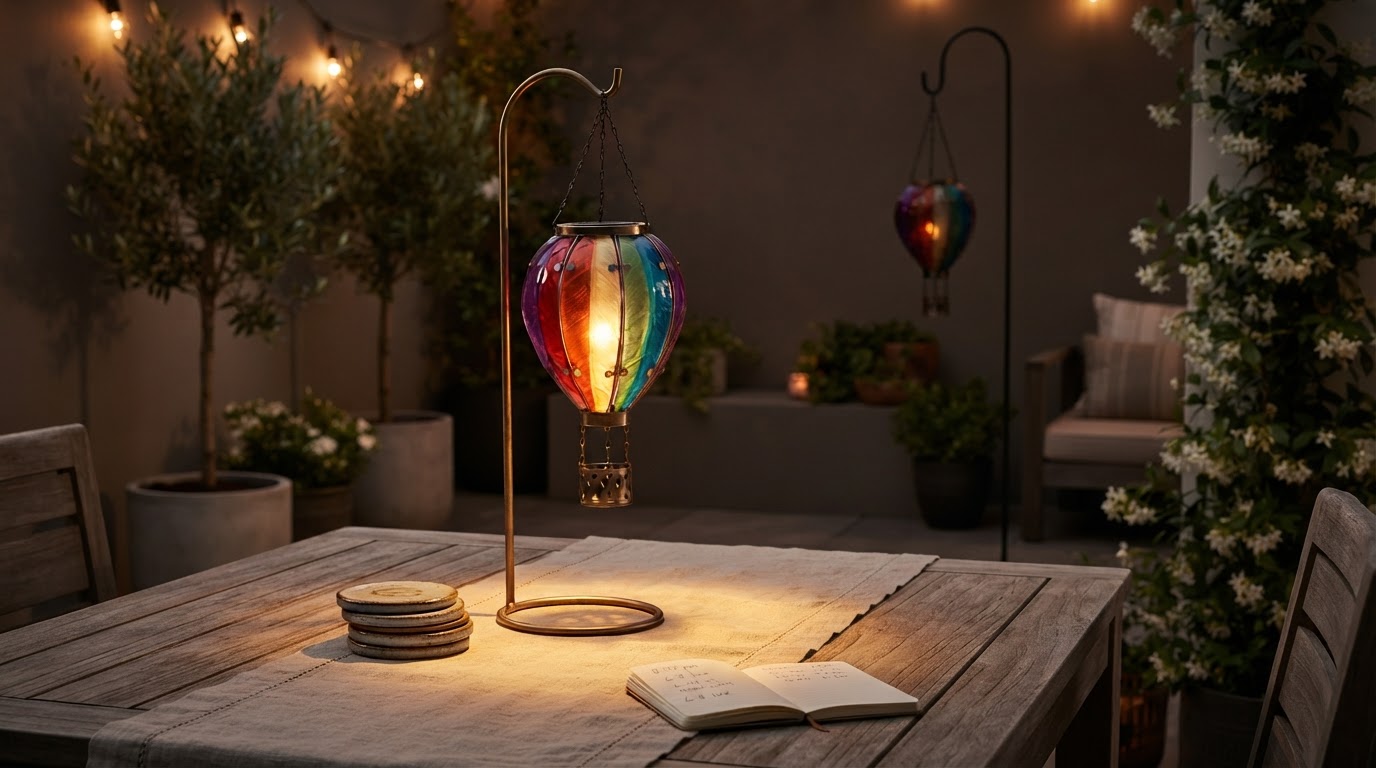
I Stopped Hanging Solar Lanterns High After One Backyard Test
 Jordan HaleStaff Writer
At 8:42 p.m., my Solar Balloon Lantern measured 6.8 lux on the table when I hung it 38 inches above the surface; when I raised the same lantern to a 7-foot shepherd hook, the table reading fell to 1.9 lux. That one small backyard test changed how I use solar lanterns.
I used to treat balloon-style solar lanterns like decoration first and lighting second: hang them high, scatter them evenly, hope the yard looks magical. They did look good in photos. But in actual evening use — eating, walking, finding a dropped bottle cap, keeping guests from stepping off the paver edge — the prettiest layout was not the most useful one.
This is my field-tested take on getting more out of a Solar Balloon Lantern without pretending it is a wired floodlight. I sell and use this style of lantern, so I care about the experience after the first night: how it charges, where it belongs, what it can and cannot illuminate, and why “brighter” is not always the right goal.
What a solar balloon lantern is actually good at
A Solar Balloon Lantern is a soft-sided outdoor lantern with a small solar panel, rechargeable battery, LED light source, and a balloon-like shade that diffuses the light. The key word is diffuses.
That diffusion is why the light feels pleasant. It spreads glow across a larger surface instead of throwing a harsh beam. It is also why the lantern should not be judged like a flashlight or security light. If you expect it to light a driveway from ten feet up, you will be disappointed. If you use it to mark a table, pathway turn, garden corner, tent line, or patio edge, it can feel surprisingly useful.
I think of it as “orientation light.” It helps people understand where things are, not perform detailed work. That distinction matters.
The Illuminating Engineering Society and many lighting designers separate task lighting from ambient and accent lighting for this reason. Outdoor decorative solar lanterns sit closer to ambient/accent lighting than task lighting. Once I stopped forcing them into the wrong category, placement became much easier.
My backyard measurement setup
Photo by Gurgenidze G on Pexels
This was not a laboratory test. It was a practical homeowner test, repeated over four evenings in late summer with one Solar Balloon Lantern fully charged in direct sun.
I used a basic handheld lux meter, took readings at table height and walkway height, and compared different placements after dusk. I avoided readings while the sky was still bright enough to skew the numbers. Weather was calm, with temperatures between 68°F and 76°F.
The most important thing I learned: height changes usefulness faster than it changes mood. A lantern hung high still looks nice from across the yard, but the surface-level light drops quickly.
Observed readings from one lantern
| Placement tested | Measurement point | Observed light level | Practical result | |---|---:|---:|---| | 38 in. above patio table | Table surface, centered below lantern | 6.8 lux | Enough to see cups, plates, and hands comfortably | | 60 in. above patio table | Table surface, centered below lantern | 3.7 lux | Pleasant glow, weaker for eating or games | | 84 in. shepherd hook | Table surface 3 ft away | 1.9 lux | Decorative, not functionally useful on the table | | 30 in. beside walkway edge | Paver surface 18 in. away | 4.4 lux | Good edge marker; feet and border visible | | 54 in. near walkway | Paver surface 18 in. away | 2.6 lux | Visible, but less helpful for uneven stones | | Under maple canopy, partial shade charge | Same table setup | 2.1 lux peak | Noticeably dimmer and shorter runtime | | Full-sun charge, 7 hr exposure | Same table setup | 6.8 lux peak | Best brightness and longest useful glow |
These numbers will vary with battery condition, season, panel size, LED design, shade color, and local sun. Still, the pattern was consistent: lower and closer beat higher and farther for usefulness.
The non-obvious placement rule I now use
Here is the rule I wish I had started with:
Place the lantern within 18 to 36 inches of the thing you want people to notice.
That “thing” might be a tabletop, a step, a chair cluster, a garden gate, a cooler, or the turn in a path. If the lantern is only meant to create atmosphere, hang it higher. If it needs to help someone move or use a space, bring it down.
For tables, I like the lantern roughly 30 to 42 inches above the surface. For paths, I prefer it low and offset, not directly overhead. For seating areas, I place it slightly behind or beside people rather than at eye level.
The balloon shade helps here because it reduces glare. A bare bright LED at 36 inches can be annoying. A diffused globe at the same height feels softer and more social.
My take: most people hang solar lanterns too high
My take: the common advice to hang outdoor solar lanterns “up high for maximum spread” is usually wrong for balloon lanterns.
It is true that higher placement lets more people see the lantern. But seeing the lantern is not the same as benefiting from its light. Because small solar LEDs have limited output, raising them often turns usable glow into distant decoration.
The inverse-square behavior of light is unforgiving: as distance increases, illumination at the surface drops sharply. A diffused shade makes the falloff feel gentler, but it does not eliminate physics. In my test, going from 38 inches to 84 inches above the useful surface cut the measured table light by more than 70%.
So I now treat height as a design decision:
- High placement: mood, silhouettes, visual rhythm across the yard
- Mid placement: dining, conversation, tabletop visibility
- Low placement: paths, steps, tent lines, garden borders
Charging matters more than most product photos admit
Solar lantern photos are usually taken at night, when the lantern is glowing. But the performance is mostly decided six to ten hours earlier.
The U.S. Department of Energy’s solar resources explain the basic issue: solar panels produce best when they receive direct, unobstructed sun, and output changes with angle, shade, and season. A tiny lantern panel is especially sensitive to shade because it has very little collection area to begin with.
In my yard, a lantern that looked “mostly sunny” under a maple canopy did not perform like one placed on an open patio table. Partial shade reduced the peak glow and shortened the useful runtime. The annoying part is that the panel did receive daylight all day — just not enough strong direct sun.
For buyers, this means the right question is not only “How long does it run?” The better question is: Where will it sit from 10 a.m. to 3 p.m.?
That five-hour window is often the difference between a lantern that glows into the evening and one that fades early.
Weather resistance: read the rating, then use common sense
Outdoor solar lanterns live in a hard environment: UV exposure, rain, wind, temperature swings, dust, and repeated charging cycles. The international standard people often see around weather resistance is IEC 60529, which defines IP ratings such as IP44, IP65, and so on.
An IP rating is useful, but it is not a magic force field. For example, splash resistance does not mean the lantern should sit in pooled water. Water-resistant fabric or plastic can still age faster if it stays wet and dirty for days.
My own habit is simple: I leave the Solar Balloon Lantern out for normal weather, but I bring it in during severe wind, hail risk, extended storms, or freezing conditions if I am not using it. That is not because the lantern is fragile; it is because small outdoor electronics last longer when they are not abused.
If you live somewhere with coastal salt air, dust storms, or heavy pollen, wipe the solar panel more often. A cloudy panel is a quiet performance killer.
Light comfort and sleep: softer is an advantage
One reason I like balloon lanterns over harsh patio lights is that they are less likely to blast people in the eyes late at night. This matters more than many buyers realize.
The NIH’s National Institute of General Medical Sciences has published accessible explanations of circadian rhythms, and research summarized through NIH resources links light exposure at night — especially brighter and bluer light — with effects on sleep timing and melatonin. I am not claiming a small outdoor lantern is a medical device or that it solves sleep problems. But I do think outdoor evening lighting should be gentle by default.
A warm, diffused lantern supports the way most of us actually use patios: talking, eating, unwinding, and transitioning toward night. I do not want my backyard to feel like a parking lot.
This is also why I do not chase maximum brightness for every outdoor space. For steps and security, yes, use appropriate lighting. For a dinner table or quiet garden corner, a softer glow often creates a better experience.
My practical setup checklist
When I help someone decide where to place a Solar Balloon Lantern, I run through this checklist:
That last step is underrated. You will notice problems immediately: a dark step, a glare spot, a panel hidden by afternoon shade, or a lantern that looks beautiful but helps nobody.
Where a Solar Balloon Lantern makes the most sense
After using these in real outdoor spaces, I think they shine in five situations.
Patio tables
This is my favorite use. Hang one low enough to make the table feel gathered but not so low that people bump it. If the lantern is centered above the table, start around 36 to 42 inches over the surface and adjust from there.
Walkway edges
Use the lantern like a visual marker. It does not need to flood the entire path. It just needs to tell the eye, “This is where the edge is.” Low side placement works better than overhead placement in my experience.
Garden corners
A balloon lantern near ornamental grass, a planter, or a small tree can create depth without wiring. It is especially effective when the light catches texture close by.
Camping and temporary setups
Solar balloon lanterns are useful around picnic tables, tent entrances, and low-traffic camp areas. I still carry a proper headlamp for tasks, but the lantern makes the shared space feel calmer.
Events and parties
For parties, I use them as glow points rather than primary illumination. Put them near drink stations, seating clusters, and path transitions. Do not rely on one lantern to do everything.
What I would not use it for
I would not use a Solar Balloon Lantern as a security light, a work light, or the only light for steep stairs. For those situations, use properly rated fixtures with enough output and reliable power.
I also would not hide the solar panel under a pergola and expect miracles. If the panel cannot see strong sun, the battery cannot store much energy. That is not a product flaw; it is how solar charging works.
FAQ
How long should a Solar Balloon Lantern charge before first use?
I recommend giving it one full day of direct sun before judging brightness or runtime. If it arrives partially charged, it may glow the first night, but that does not tell you much. Place the solar panel where it gets several hours of direct sun, not just bright shade.
Can I leave a [solar balloon lantern outside](/blog/selecting-solar-balloon-lantern-garden-lighting) in the rain?
For normal outdoor use, yes, if the product is designed and rated for outdoor exposure. Still, do not submerge it, leave it sitting in pooled water, or ignore severe weather. IP ratings describe levels of protection under defined test conditions, but long-term durability also depends on care, storage, wind, UV, and dirt.
Why is my lantern dim even after a sunny day?
The most common causes I see are partial shade, a dirty panel, poor panel angle, old rechargeable battery performance, or the lantern being placed too far from the area you expect it to illuminate. Try charging it in a known full-sun spot for a day, clean the panel, then test it closer to the target surface.
Is a solar balloon lantern bright enough for reading outside?
Usually, no — not comfortably for most people. It may let you read a menu, check a label, or find something on a table, but sustained reading is a task-lighting job. I would use the lantern for atmosphere and orientation, then add a dedicated reading light if that is the goal.
The decision framework I use before buying another lantern
Before adding more lights, I ask three questions:
This keeps me from buying brightness I do not need or placing a nice lantern where it cannot perform.
The Solar Balloon Lantern is not trying to compete with hardwired landscape lighting. Its strength is softer: portable glow, easy placement, no outlet, no trenching, and a friendlier feel than exposed LEDs. When I place it low enough and charge it honestly, it does exactly what I want — it makes the yard easier to inhabit after sunset.